


Transporting prefabricated timber parts safely – 7 common mistakes
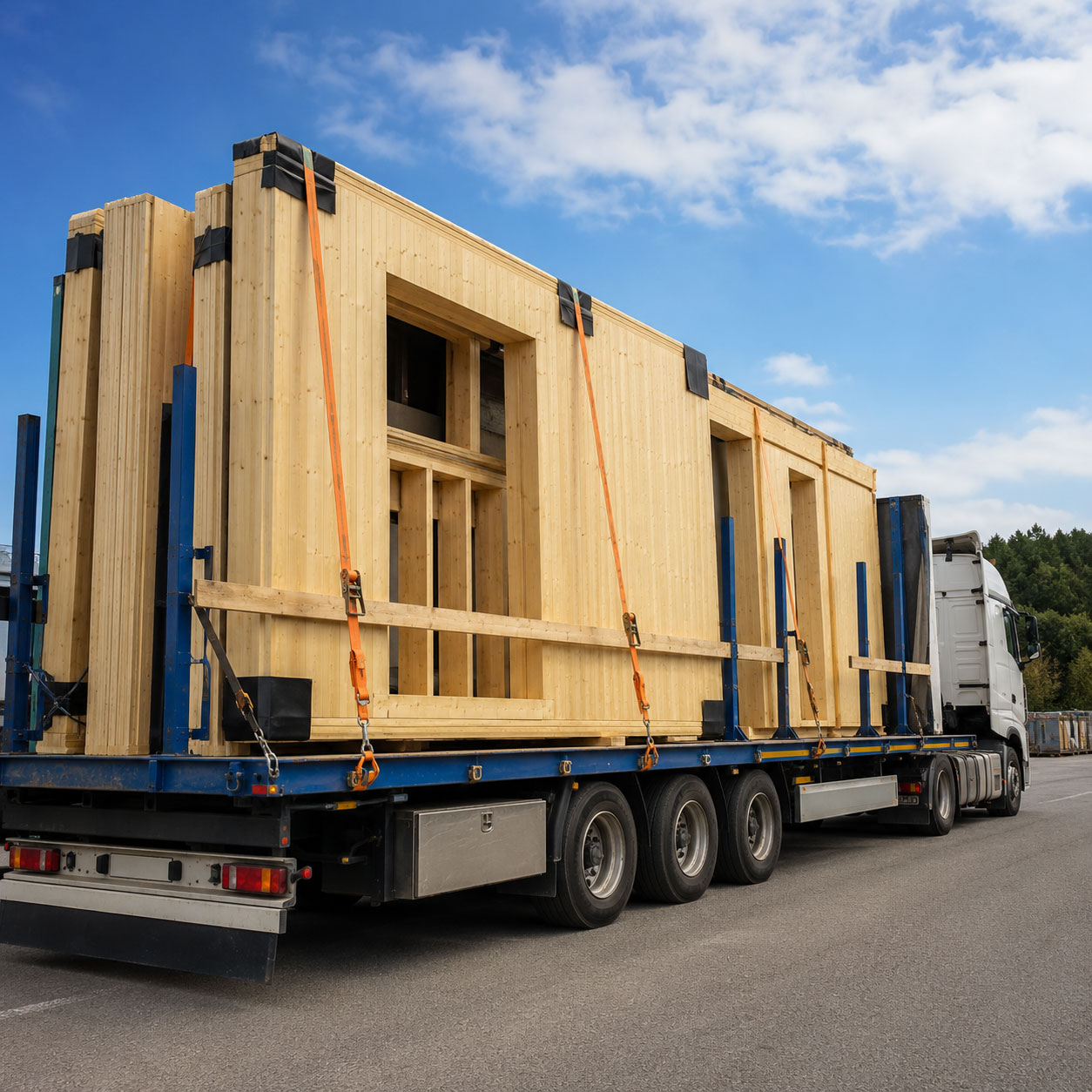
Prefabricated timber construction is booming. More and more houses are being built from prefabricated timber frame or solid wood walls, which are produced in the factory and delivered directly to the construction site. However, the same mistakes keep happening during transportation – with expensive consequences: damaged surfaces, delayed construction sites and, in the worst cases, dangerous situations for staff.
R-TECH has been supporting precast plants and transportation companies for more than 30 years. In the process, we have become very familiar with the typical weak points in the transportation of prefabricated timber elements. Here are the seven most common mistakes – and how to avoid them.
Error 1 - Incorrect support points
Prefabricated timber elements have defined load application points - often specified by the statics. If the elements are supported at the wrong points, undesirable bending moments occur, which can lead to cracks, deformations or even breakage.
<strong>Solution:</strong> Always know the static documentation of the precast element and configure the transport frame accordingly. R-TECH offers product-specific solutions that are tailored to the respective precast elements.
Error 2 - Direct metal contact with the wood surface
Steel and wood - an unfavorable combination. Metal parts of the transport frame leave pressure marks, scratches and, in the case of moisture, discoloration on exposed wood surfaces. This damage is almost impossible to repair and leads to complaints and subsequent costs.
<strong>Solution:</strong> Use securing elements with a plastic or rubber coating. R-TECH's locking blades and pins are provided with a plastic coating as standard.
Error 3 - Insufficient securing against tipping
Wooden walls are large, but often relatively light - and therefore susceptible to wind. An unsecured element can tip over in strong gusts of wind during transportation, but also when being set down on the construction site. Particularly critical: sloping or uneven surfaces.
<strong>Solution:</strong> Use transport racks with integrated, reliable support systems. The support must also function stably on uneven ground - and be intuitive to operate so that it can be used correctly even under time pressure.
Error 4 - Overloading the transport rack
Too many elements on one frame - at first glance, this saves time and trips, but it harbors considerable risks. Excessive loads exceed the load-bearing capacity of the frame, reduce stability and, in extreme cases, can lead to the structure failing.
<strong>Solution:</strong> Always adhere to the specified payload of the transport rack. Each R-TECH frame is equipped with clearly defined load limits that have been determined on the basis of real test procedures.
Fault 5 - Missing or incorrect lashing securing
Even the sturdiest transport rack will not protect you if the load on the vehicle is not correctly secured. Lashing straps that are too loose, incorrectly positioned or do not comply with the standard can fail when cornering, braking or on uneven surfaces.
<strong>Solution:</strong> Implement lashing in accordance with DIN EN 12195. Regular driver and loader training is not a luxury, but an investment in safety and liability prevention.
Error 6 - No visual inspection before transportation
Transport racks are robust work equipment - but they wear out, can be damaged or show signs of fatigue. If you simply load the frame without checking it briefly beforehand, you run the risk of any damage only becoming critical during transportation - or on the construction site.
<strong>Solution:</strong> Carry out a brief visual inspection before each loading: Are all securing elements present and intact? Does the frame show cracks, deformations or missing parts? If so, do not use it, but report it immediately.
Mistake 7 - Incorrect storage on the construction site
Transportation is not the end of the chain of danger. A lot of damage occurs when ready-delivered timber elements are temporarily stored on the construction site - on sloping ground, without sufficient support, or exposed to the weather for too long.
<strong>Solution:</strong> Set up transport racks, which are also suitable as temporary storage racks, correctly and plan the storage location in advance. Do not store elements outdoors for unnecessarily long periods.
Conclusion: Safety starts with the right frame
Many of the errors mentioned can be largely eliminated by two measures: firstly, the selection of a high-quality rack that is tailored to the transported goods - and secondly, the consistent training of all those involved. R-TECH offers both: tried-and-tested transport racks with our own safety tests and personal advice tailored to your specific finished parts and logistics processes.
<strong>Ready to optimize your transport processes?</strong>
R-TECH advises you personally - for timber and precast concrete parts. <a href="mailto:office@r-tech.at">office@r-tech.at</a> | +43 (0) 2638 / 77735 | <a href="https://www.r-tech.at">www.r-tech.at</a>