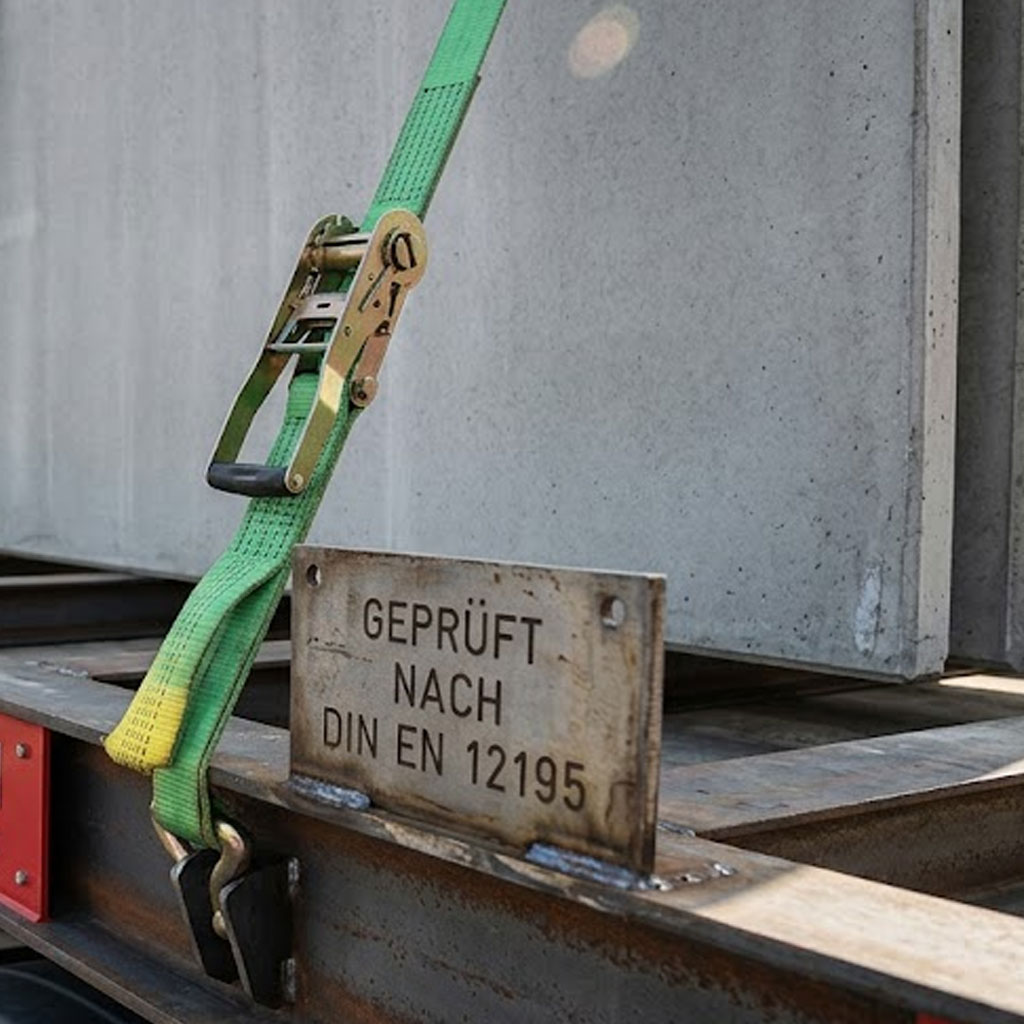
Load securing: What does DIN EN 12195 say?
Anyone who transports prefabricated concrete or wooden parts bears a great responsibility – not only for the goods, but for all road users. Unsafe loads can lead to disaster in an emergency. So it’s no wonder that the legislator has laid down clear rules. The most important standard for practical use: DIN EN 12195.
Important note: This article is for general information only and does not replace legal or specialist advice. If you have specific questions about the conformity of your transport systems to standards, please contact an authorized expert or R-TECH directly.
What is DIN EN 12195?
DIN EN 12195 is a European standard that defines the requirements for load securing equipment and its correct use in road transportation. It is divided into four parts:
- DIN EN 12195-1: Calculation of securing forces
- DIN EN 12195-2: Lashing straps made of man-made fibers
- DIN EN 12195-3: Lashing chains
- DIN EN 12195-4: Lashing wire ropes
Part 1 is particularly relevant for precast construction: It specifies which forces act on the load during deceleration, acceleration and cornering – and how these must be absorbed by suitable securing devices and transport frames.
What is the legal basis in DACH?
In Germany, Austria and Switzerland, load securing in road traffic is primarily governed by the respective national road traffic law (in Germany § 22 StVO, in Austria § 101 KFG). As a technical standard, DIN EN 12195 does not have direct legal force, but is considered a recognized rule of technology – and thus as proof of standard-compliant action during inspections or in the event of damage.
In plain language: if you comply with the standard, you are on the safe side. Anyone who deviates from it must prove that their solution is equally safe in case of doubt.
Special challenges for transporting prefabricated parts
Precast concrete parts and large wooden construction elements place special demands on load securing – for several reasons:
- High dead weight, narrow footprint: concrete walls are heavy and towering. Their center of gravity is often far above the contact area. Even moderate lateral acceleration – for example in bends or during evasive maneuvers – results in considerable tilting moments. The transport frame must reliably absorb these forces.
- Wind loads during parking: Even after transportation – when the precast elements are temporarily stored on the construction site – stability remains critical. Gusts of wind can exert considerable forces on large, flat elements. For this reason, transport frames must also be designed in accordance with standards as temporary storage facilities.
- Surface protection: Exposed concrete surfaces and wooden surfaces must not only arrive safely, but also undamaged. Direct metal contact leads to pressure marks and scratches. This is why securing elements with suitable protective covers (e.g. plastic covers such as those from R-TECH) are not only a quality feature, but also part of professional load securing.
What does this mean for your transport rack?
A standard-compliant transport rack for precast elements should meet the following requirements:
- Sufficient load capacity for the intended load (with safety factor)
- Stability even under driving conditions (cornering, braking, uneven road)
- Documented test procedure and test certificate
- Simple, error-free handling – even under construction site conditions
- Protection of the load surface from damage by securing elements
The R-TECH approach: safety through our own test procedures
R-TECH goes one step further in terms of safety than required by law. All inloader pallets and swap bodies are tested according to our own practice-oriented test procedures, which are based on real transport conditions. The result: products that are not only safe on paper, but also function reliably in daily operation on construction sites throughout Europe.
The integrated support systems of the R-TECH frames are also designed so that they can be operated intuitively on the construction site – which minimizes operating errors and thus ensures safety even in stressful work situations.
The most important facts at a glance
- DIN EN 12195 is a recognized rule of technology – anyone who complies with it is acting in accordance with the standard
- Part 1 is particularly relevant for precast companies: Calculation of securing forces
- Transport frames must reliably absorb tilting moments, wind loads and driving dynamics
- Protective overlays on securing elements are not a luxury, but part of correct load securing
- Test certificates and test protocols provide legal protection in the event of damage
- Regular driver training and rack checks are mandatory – not optional
Are you planning to purchase standard-compliant transport racks?
R-TECH provides you with expert advice based on 30 years of experience in transporting prefabricated parts. Talk to us: office@r-tech.at | +43 (0) 2638 / 77735 | www.r-tech.at
FAQ